120 Days Mon - Fri From (10 AM - 10 PM) IST
Odoo

5 MIN READ

October 13, 2025

As the healthcare industry evolves, digital transformation is no longer a choice-it’s a necessity. From patient registrations and appointment scheduling to medical records and billing, nearly every function is now handled electronically. Odoo, with its modular and customizable ERP structure, has become an increasingly popular choice for healthcare organizations looking to streamline operations.
But with great power comes great responsibility. Managing such a vast amount of sensitive data comes with the challenge of ensuring patient privacy and maintaining data security. Healthcare professionals and organizations must adhere to strict regulatory frameworks, avoid breaches, and most importantly, earn and keep the trust of their patients.
This is where Role-Based Access Control (RBAC) plays a vital role. In this blog, we’ll explore how RBAC helps in managing patient data securely in Odoo, why it’s important for healthcare ERP systems, how to implement it, and how tools like Access Manager Ninja can make the process significantly easier and more secure.
Healthcare organizations deal with a highly sensitive and regulated category of data personally identifiable information (PII) and protected health information (PHI). This includes:
A breach of this information can have catastrophic consequences. Patients may suffer emotional, financial, or even physical harm. Meanwhile, healthcare providers can face severe penalties, lawsuits, and irreparable damage to their reputations.
Data protection laws such as HIPAA in the United States, GDPR in Europe, and emerging data privacy acts in regions like India and Southeast Asia place stringent requirements on how healthcare data must be stored, accessed, and processed. One of the fundamental requirements across all these regulations is restricting access to data based on roles and responsibilities.
Even the most secure ERP platform, if left with unrestricted access to all users, becomes a liability. Odoo is a powerful ERP, but out of the box, it doesn’t provide the healthcare-specific access controls needed to manage compliance and confidentiality efficiently. That’s why implementing a structured, role-based access strategy is essential.
Also Read: How Access Manager Ninja Can Help Companies in Today’s Time
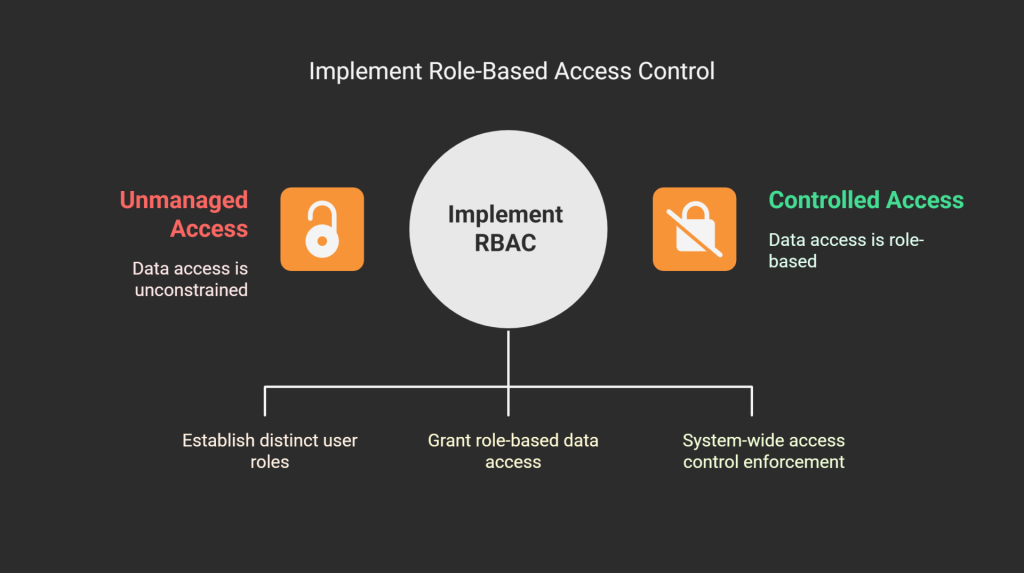
Role-Based Access Control (RBAC) is a method of managing user access based on their job role within the organization. Rather than setting up permissions for every individual user-which becomes unmanageable as your team grows—you assign roles such as “Doctor”, “Nurse”, “Receptionist”, or “Billing Staff”, and define what each role can or cannot do within the system.
Each role has access to only the modules, records, and functionalities that are necessary to perform their job duties. This principle is also known as the “Principle of Least Privilege”-users should only have access to the information and tools they absolutely need.
For example:
RBAC doesn’t just limit what people can view; it also controls who can create, edit, delete, or approve records. This level of fine-grained control is crucial in any healthcare environment where privacy and compliance are non-negotiable.
Also Read: Efficiently Manage Model Access Permissions in Odoo with Access Manager Ninja
Implementing RBAC in Odoo for healthcare brings a wide range of benefits, not only in terms of compliance but also in organizational efficiency, security, and clarity of operations.
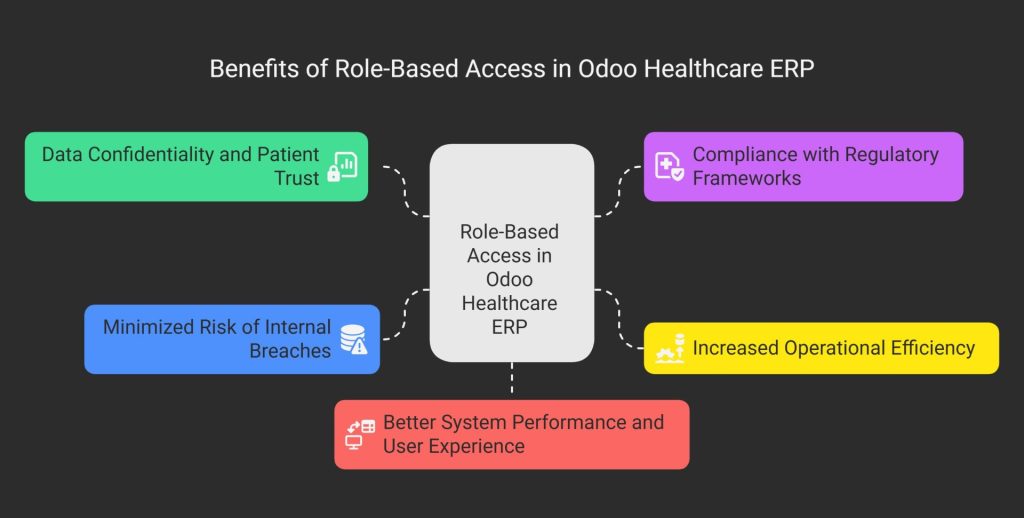
When users only have access to the data they need, the risk of intentional or accidental data exposure is significantly reduced. This helps build patient trust-patients are more likely to engage with your organization when they know their personal health information is secure and accessible only by relevant healthcare professionals.
Healthcare organizations are subject to complex regulatory requirements. HIPAA, for example, mandates strict controls over who can view or modify PHI. RBAC helps organizations stay compliant by enforcing clear boundaries between roles and ensuring that only authorized users access specific datasets.
During audits or investigations, having a well-documented and enforced RBAC system helps demonstrate due diligence and adherence to legal requirements.
With role-specific interfaces and access levels, employees don’t waste time navigating irrelevant modules or data. A nurse doesn’t need to access billing menus, and a billing officer doesn’t need to sort through patient notes. This clarity leads to faster workflows, fewer errors, and better focus on critical tasks.
Not all data breaches come from external hackers. Many incidents arise due to internal misuse or negligence. RBAC minimizes these risks by reducing access points and ensuring users can’t accidentally or maliciously access information outside their scope.
RBAC can streamline the user experience. By hiding unnecessary menus and fields for each user type, your Odoo interface becomes cleaner, simpler, and easier to use. This is particularly useful in busy environments like hospitals, where every second counts.
Securing your healthcare ERP system through role-based access in Odoo involves a structured approach. Here are the key steps involved:
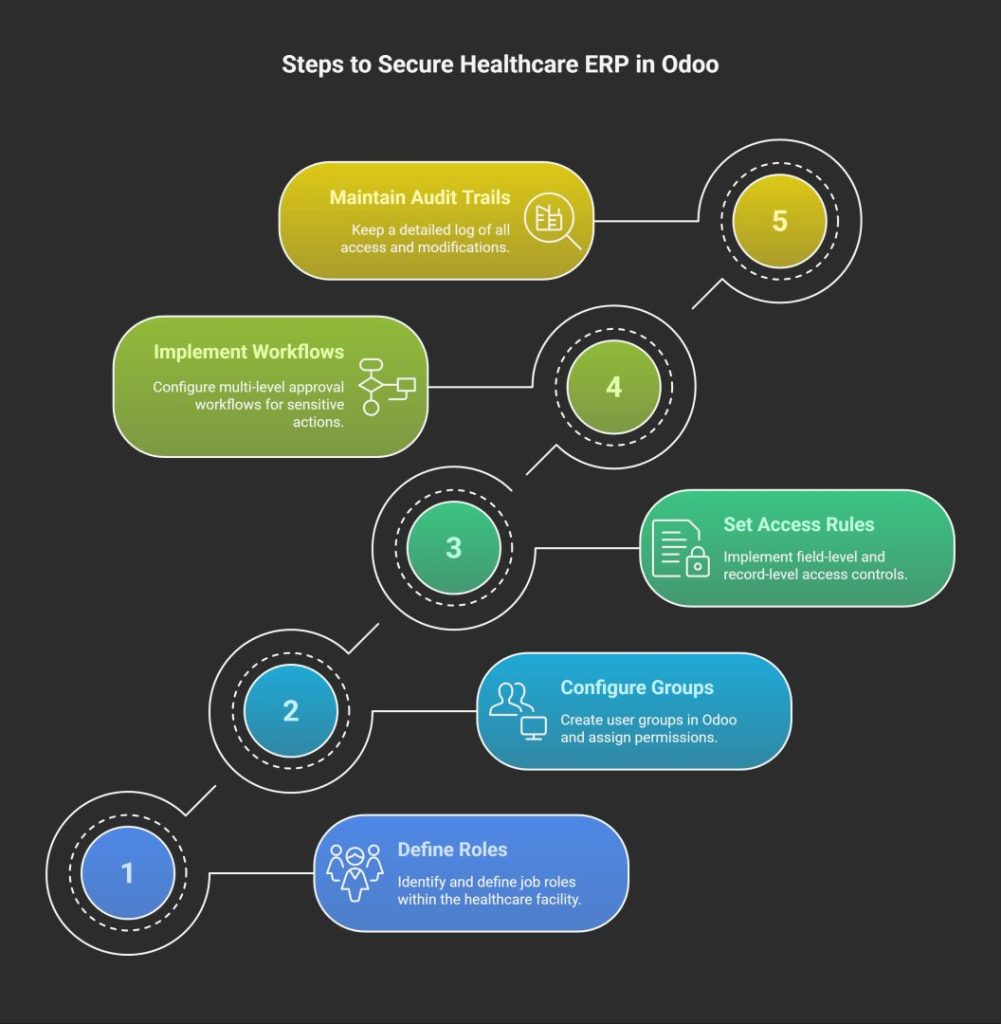
Start by identifying the various job roles within your healthcare facility. These might include general physicians, specialists, nurses, pharmacists, front desk staff, lab technicians, billing administrators, compliance officers, and IT managers. For each role, define what types of data and actions are necessary for their daily tasks.
Odoo allows the creation of user groups, which act as roles. Assign users to specific groups and configure permissions for each group. At this stage, define access to modules (like Appointments, Invoices, Lab Results, etc.) based on necessity.
However, this native functionality in Odoo is relatively basic and works at the model level. For advanced field-level or record-level security, customizations or third-party modules are required.
Use Odoo’s record rules and access controls to ensure that a user can only view or modify records assigned to them or their department. For example, you can limit lab results to be visible only to the lab staff and assigned physicians.
Field-level control is even more sensitive. Certain fields, like diagnosis comments or confidential flags, may need to be hidden or read-only for specific roles.
For actions that are high-risk or require validation-like generating prescriptions, discharging patients, or issuing invoices—configure multi-level approval workflows. This ensures that sensitive decisions are reviewed before becoming official.
Every access or modification should be traceable. Maintain a full audit trail that shows who accessed which records and when. This is essential for compliance audits, incident investigations, and maintaining organizational transparency.
Also Read: How to Manage User Access in Odoo: Best Practices for Security and Efficiency
Understanding how RBAC functions in practice can help visualize its importance. Here are a few examples of how properly implemented access controls can work in Odoo:
A Dr. logs into the Odoo system. She can:
However, dr. cannot access another doctor’s patients, modify financial records, or change system settings.
A Nurse is part of the critical care team. His access is limited to:
Nurse cannot see billing information, prescription details, or lab results.
Receptionist uses Odoo to:
Receptionist cannot access medical records or diagnostic reports, keeping patient confidentiality intact.
Without a well-defined RBAC system in place, organizations expose themselves to numerous operational and compliance risks:
Also Read: Access Control in Odoo for Healthcare with Access Manager Ninja
While Odoo provides a basic framework for access control, it lacks the depth and flexibility needed for complex organizations-especially in healthcare. That’s where Access Manager Ninja by Ksolves makes a big difference.
Access Manager Ninja is a purpose-built module designed to bring fine-grained, scalable, and intuitive access management capabilities to Odoo.
For healthcare providers using Odoo, this tool removes the guesswork from access management and provides a robust foundation for long-term data security.
Try Access Manager Ninja and elevate your data security strategy.
Healthcare ERP systems are central to the modern care environment, and Odoo is one of the most powerful and flexible platforms available today. But the default access controls in Odoo are not sufficient when it comes to managing sensitive healthcare data. Implementing Role-Based Access Control (RBAC) is essential to maintain patient privacy, ensure compliance, and enhance the overall efficiency of your organization.
By defining roles clearly, limiting access intelligently, and using tools like Access Manager Ninja, you can transform your Odoo environment into a secure, compliant, and streamlined healthcare ERP system. Your patients will thank you, your staff will work more efficiently, and your organization will operate with the confidence that comes from knowing its data is protected.
If you’re serious about securing Odoo for healthcare, Access Manager Ninja is a smart investment that saves time, mitigates risk, and simplifies complexity.